THE SHORT VERSION
Separate heel-to-toe difference from total sole thickness. Compare familiar submaximal work with one footwear change at a time, and keep the shoe recorded beside the lift.
Heel height and sole thickness are different
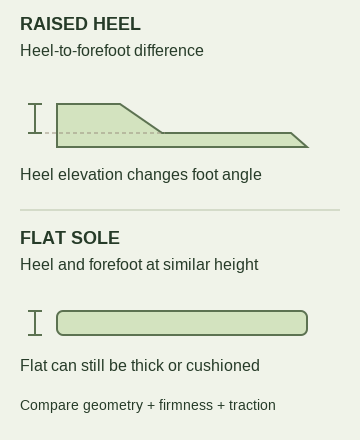
Heel elevation describes the difference between the rearfoot and forefoot support. Stack or sole thickness describes how much material is underneath. A flat platform can still be thick, and a raised-heel shoe can have a firm sole. When comparing products, record the manufacturer's stated measurement and definition instead of treating every use of 'heel height' as the same number.
Also inspect fit, fastening, grip on the actual floor and whether the sole compresses noticeably. A soft running shoe and a firm flat lifting shoe are not interchangeable just because both look low at the heel. You need a stable, repeatable setup for the chosen lift, rather than a footwear label alone.
For squats, test the position you intend to use
A raised heel changes the foot's starting geometry. Squat research has often found differences in trunk lean and joint motion when comparing footwear or heel elevation, but the response is not uniform. A 2021 review of fourteen articles reported that many included studies found kinematic or kinetic differences and called for broader participant samples and better separation of sole stiffness from heel elevation.
That evidence gives you a reason to compare, not a rule that every high-bar squat needs a heel or every low-bar squat needs flats. Keep bar position, stance, intended depth and load stable during your comparison. If you change all four, you have tested two different squat setups rather than the footwear alone.
Sources: Pangan and Leineweber (2021): footwear and heel-elevation review
For deadlifts, consider the floor-to-bar relationship
With the same plates on the same floor, adding material under your feet raises your body relative to the starting bar. That is a geometry change, not an automatic prediction of the weight you can lift. A thin, firm sole may make a useful comparison, but grip on the floor and secure fit still matter. A slippery thin shoe is not a good trade for a familiar stable setup.
Conventional and sumo setups place different demands on stance and foot position. Use the style you actually train when testing traction and comfort. Do not infer that a shoe which feels good in a narrow-stance warm-up will behave the same in your wider stance. Check floor condition too; dust, moisture and a loose mat can change the interaction without any change in the shoe.
The squat studies cited here do not establish a deadlift-performance advantage. This section is a practical comparison framework based on the setup geometry. Keep deadlift records with the shoe and sole condition labelled, especially if you also switch bars, plate diameter or pulling height.
Do not turn posture findings into injury promises
A study of fourteen recreational lifters, seven men and seven women, compared flat barefoot, heel-raised barefoot and weightlifting-shoe conditions during squats at 80% of one-rep maximum. It did not find significant differences in the measured trunk angles or muscle-activation outcomes. That result sits alongside studies reporting other footwear effects; it is a useful check against a universal 'more upright' claim.
These are measurements under specific test conditions, not long-term trials showing that one shoe prevents back or knee injuries. They also do not give a guaranteed increase in a squat total. Choose language such as 'this setup lets me reach my intended depth consistently' when that is what you observed, rather than turning a personal preference into a medical conclusion.
Sources: Pangan and Leineweber (2021): footwear and heel-elevation review; Lee et al. (2019): heel-raised squat conditions
Run a consistent comparison and log the result
| Hold steady | Record | Review |
|---|---|---|
| Lift, bar position and stance | Shoe model; sole and heel information | Depth or start-position consistency |
| Load, reps and intended effort | Floor, warm-up and session order | Traction, comfort and control |
| Camera position if filming | Any changed variable | Whether another comparable session agrees |
Start with an unloaded or easy warm-up check so unfamiliar footwear is not introduced under a maximal load. If the basic setup works, compare the familiar work your program already permits; do not add a max test just to pick shoes. Review more than one session where practical. A single better day may reflect readiness rather than the equipment.
Check footwear rules before a meet
IPF rules require shoes or boots and name eligible indoor sports footwear, weightlifting/powerlifting boots and deadlift slippers. The sole may not exceed 5 cm at any point; the underside must meet the flat-surface rule. Loose additional insoles are limited to 1 cm. The rulebook also requires proper fastening and excludes socks with a rubber outside sole lining.
Those are eligibility rules, not an instruction to use a 5 cm sole or add an insole. Read your event's current rules and check any uncertainty before competing. Barefoot may be a research condition or a gym practice, but it does not follow that it is allowed on your meet platform. Keep the training comparison and the competition decision connected.
Sources and scope
These references support the specific factual points cited above. The examples and decision aids are original illustrations, not individualized coaching or medical advice.
- Pangan and Leineweber (2021): footwear and heel-elevation review
Abstract checked November 25, 2026. Fourteen included articles; describes squat biomechanics and population/design limitations. Does not establish a universal injury-prevention or deadlift benefit.
- Lee et al. (2019): heel-raised squat conditions
Abstract checked November 25, 2026. Fourteen recreational lifters tested at 80% 1RM; no significant effects on reported trunk-angle or muscle-activation outcomes. Acute measurements, not an injury-incidence trial.
- IPF Technical Rulebook, March 2026 v3
Section 3.7 supports footwear eligibility, sole and loose-insole limits, fastening and rubber-soled-sock exclusions. Official current-version link and relevant text checked November 25, 2026; applies to IPF competition.
A goal worth keeping track of.
1000 Pound is building a mobile app around your squat, bench, deadlift, and the real singles that make up your total. Coming soon for iOS and Android.
Release news and the current first-year-free offer. No payment details needed.