Compare styles after learning both setups. Match conditions and effort as closely as practical, and keep separate style-specific records.
Recognize the stance-and-hand relationship
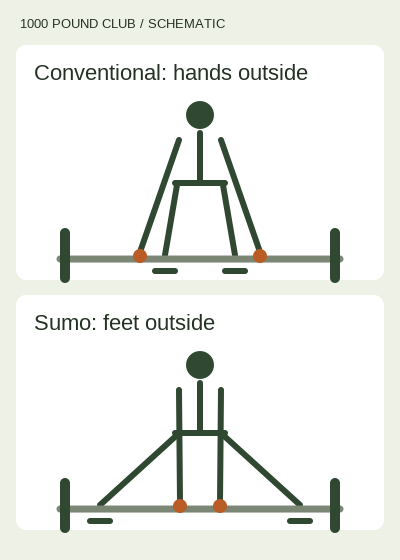
Conventional generally starts with a narrower stance and the arms outside the legs. Sumo generally uses a wider stance with the arms between the legs. There is room for individual variation within each. The aim is a position from which you can create tension and lift the bar with control, not matching a fixed distance between your shoes.
Keep the bar close enough to set up without an unnecessary reach, then practise the relationship of feet, hands and hips with a manageable load. A wider stance also needs enough usable space on the platform and clear foot placement. Learning the position with appropriate instruction is more useful than immediately testing which version produces the heaviest first-day pull.
Sources: Greg Nuckols: How to Deadlift
Expect different mechanics without a universal winner
| Feature | Conventional | Sumo |
|---|---|---|
| Feet relative to hands | Inside | Outside |
| Arm position | Outside the legs | Between the legs |
| Torso / start geometry | Often more forward inclination | Often more upright |
| Progress record | Conventional deadlift | Sumo deadlift |
The wider stance changes the three-dimensional task. A side-view photo alone cannot tell you the complete hip demands, and a shorter-looking bar path is not a complete explanation of performance. Proportions, stance, technique history and available positions all matter. Nuckols’ deadlift guide explains why the comparison cannot be reduced to a single horizontal distance from bar to hip.
Avoid using cheating or universally easier as technical categories. A lifter may be stronger in one style, and another lifter may show the opposite pattern. Your current difference can also change with practice. The practical question is whether a style serves your training or competition goal, rather than whether it wins an argument based on one photograph.
Sources: Greg Nuckols: How to Deadlift
The same deadlift rules apply to both styles
The current IPF deadlift description does not prescribe one of these two stance names. It requires the bar in front of the feet, a grip in both hands, and a completed standing position under its rules. Both conventional and sumo can be judged against that standard. The style does not remove the need for the required finish, the down command or controlled return.
Use the current wording for the finish rather than an exaggerated lean-back cue. Our lockout guide explains the knee and shoulder requirements and the common causes of failure. Straps, grip choice and equipment eligibility are separate issues: practising sumo with straps does not make that exact strapped attempt an eligible IPF competition lift.
Set up a practice comparison you can interpret
- Give both setups enough light practice to identify a repeatable starting position.
- Use the same bar, plate diameter, shoes, grip aid policy and rep style for comparable sessions.
- Write a similar intended effort and rep prescription; loads may differ by style.
- Alternate which style gets the fresher practice slot across sessions, or compare each in its own consistent slot.
- Review control, completed work and effort before deciding whether heavier practice is useful.
Matching load is not the same as matching relative difficulty. If 100 kg is comfortable conventional work but a hard sumo set during the learning phase, those entries test different effort levels. Keep both the absolute load and reported effort. Our worksheet leaves space for these details rather than collapsing them into a supposed stance score.
An example that does not declare a premature winner
| Session | Style / conditions | Completed work | Interpretation |
|---|---|---|---|
| 1 | Conventional, dead-stop, no straps | 100 kg × 3; comfortable | Established-style baseline |
| 2 | Sumo, dead-stop, no straps | 90 kg × 3; setup still variable | Learning entry, not a max comparison |
| 3 | Sumo, same conditions as 2 | 90 kg × 3; more repeatable | Technique observation at the same load |
There is no ten-kilogram prediction about long-term potential in this table. The second style is less familiar, and none of the entries is a maximal single. A more repeatable third session is useful information without becoming a claim that your competition total increased. Keep future attempt goals separate from work you have already completed.
Choose a main style while keeping the other’s role clear
If you compete, choose a main style you can practise consistently under the relevant rules. The other can remain assistance if the program has a reason for it and the workload fits. You do not need to train both equally forever, and you do not need to change styles after every hard session. Separate a deliberate learning block from a reaction to one missed rep.
When a familiar style stalls, review comparable work, setup, rests and attendance before assuming the stance is the cause. A new variation changes the task and may expose a useful practice need; it does not diagnose the old problem. Keep each style’s best sets visible so a later decision rests on a history of actual training rather than the novelty of a single session.
Sources and scope
These references support the specific factual points cited above. The examples and decision aids are original illustrations, not individualized coaching or medical advice.
- Greg Nuckols: How to Deadlift
Coaching reference checked November 23, 2026, including stance, Romanian deadlifts and reset versus touch-and-go reps. We do not adopt its specific mobility protocol or infer injury rates.
- IPF Technical Rulebook, March 2026 v3
Current English version on the IPF rules page, checked November 23, 2026. Rules of performance and equipment define competition eligibility; our training examples are separate.
A goal worth keeping track of.
1000 Pound is building a mobile app around your squat, bench, deadlift, and the real singles that make up your total. Coming soon for iOS and Android.
Release news and the current first-year-free offer. No payment details needed.