Track the bar position alongside depth, stance and equipment. A new low-bar record is not automatically an improvement in your high-bar squat.
The difference starts with the bar’s support
High-bar placement generally uses the upper trapezius shelf. Low-bar placement uses a lower shelf around the rear deltoids, with the torso and arms arranged to support that position. Neither means resting the load on the neck or trying to carry it entirely in the hands. Find a stable position before unracking, and use rack safeties and suitable spotting.
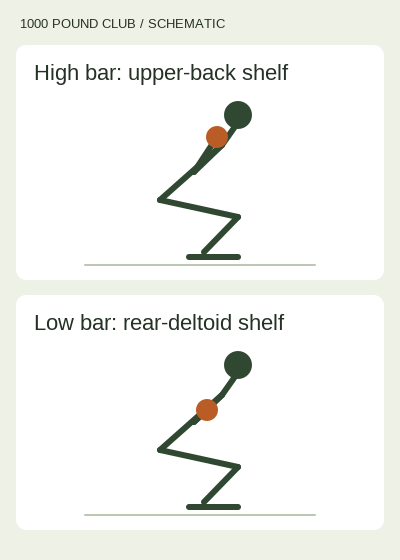
The drawing deliberately avoids a degree target. A small shift in where the bar is supported interacts with torso length, stance and how the knees and hips move. Greg Nuckols’ mechanical discussion explains why two fixed silhouettes cannot represent every high-bar and low-bar squat. Use the labels to identify the variation, then review the movement you actually perform.
Sources: Greg Nuckols: How to Squat; Greg Nuckols: High Bar and Low Bar Squatting 2.0
What can change, and what the label cannot tell you
| Feature | High bar | Low bar |
|---|---|---|
| Support | Upper-back / trapezius shelf | Lower rear-deltoid shelf |
| Torso tendency | Often more upright | Often more inclined |
| Hands and elbows | Arrange to support the shelf | May need a different grip and elbow setup |
| Record label | High-bar back squat | Low-bar back squat |
These are common tendencies rather than required positions. A low-bar squat is still a squat involving the knees and hips, and a high-bar squat is not a quad isolation exercise. The load, range of motion and lifter’s proportions affect the demands. Avoid inferring which muscle is weak from bar position alone or copying a deliberately exaggerated forward lean.
Some lifters handle more weight low bar; that is not a reliable percentage conversion for your own records. Familiarity also matters. A lifter who has practised high bar for years and low bar for two sessions has not run a balanced test of the two positions. Keep practice history in the comparison rather than calling the first result a permanent limit.
Both still have to meet the squat standard
The current IPF rule describes a bar placed horizontally across the shoulders, no lower than posterior-deltoid level. It does not award a different depth standard to a low-bar squat. The lift must satisfy the same rules of performance, including the required depth and commands. A training label such as powerlifting squat does not establish that a particular rep meets those rules.
Check your own federation before competing. For practice video, use a view where the hip-side thigh and knee landmarks are visible; do not judge depth from how upright the torso looks. We keep the complete landmark explanation in the squat-depth guide so this comparison can focus on bar position and training use.
Compare the setup before comparing heavy loads
- Choose one manageable load and a rack setup that lets you practise without a max test.
- Locate a secure bar shelf and grip before unracking; get coaching help if the position is unclear.
- Keep shoes, stance notes, depth target and rep prescription recorded.
- Review several sessions of each variation, including comfort and consistency.
- Only compare progress within a well-labelled variation; use the program’s own loading rules.
A useful first question is whether you can reproduce the shelf and walkout, not whether the new position immediately beats your old best. If the bar rolls or the hands are taking the load, resolve the setup instead of tightening every cue and adding weight. Persistent discomfort is a reason to reassess the position with appropriate help, not evidence that a variation must be mastered at any cost.
A log that keeps the result interpretable
| Entry | Lift and conditions | Result | Meaning |
|---|---|---|---|
| A | High bar; same shoes; intended depth | 90 kg × 5, 3 sets | High-bar baseline |
| B | Low bar; learning a new shelf | 80 kg × 5, 3 sets | Low-bar practice baseline |
| C | High bar; conditions match A | 92.5 kg × 5, 3 sets | Comparable high-bar load increase |
Entry B is not a ten-kilogram loss in squat strength. It is a different variation during a learning phase. Entry C is more comparable with A because the bar position and task match. Even then, keep effort and depth notes: a heavier set with a shorter movement is not the same result. Record completed reps rather than filling the planned number into the result field.
Choose the position for its role in your training
For a powerlifter, a competition back-squat position needs enough consistent practice to be usable on the platform. Another bar position can be assistance work if the program gives it a purpose and an appropriate load. It does not need to replace the competition lift just because a diagram makes it look more upright or a friend lifts more with it.
Keep the decision concrete: which setup is stable, which lift are you preparing to perform, and can the weekly plan accommodate another variation? If progress has stalled, diagnose the actual pattern before switching bar positions. A different shelf may change the task, but it does not by itself explain missed sessions, insufficient rests or a poor load progression.
Sources and scope
These references support the specific factual points cited above. The examples and decision aids are original illustrations, not individualized coaching or medical advice.
- Greg Nuckols: How to Squat
Coaching and biomechanics reference checked November 23, 2026. Supports setup concepts, not an individualized stance, an injury prediction or our illustrative loads.
- Greg Nuckols: High Bar and Low Bar Squatting 2.0
Coaching analysis checked November 23, 2026. Bar location and whole-body mechanics interact; its models are not universal joint angles or a guaranteed performance difference.
- IPF Technical Rulebook, March 2026 v3
Current English version on the IPF rules page, checked November 23, 2026. Rules of performance and equipment define competition eligibility; our training examples are separate.
A goal worth keeping track of.
1000 Pound is building a mobile app around your squat, bench, deadlift, and the real singles that make up your total. Coming soon for iOS and Android.
Release news and the current first-year-free offer. No payment details needed.