Compare like rep styles, note any bounce or reset, and keep rep-max estimates separate from completed single-rep records.
What happens between repetitions?
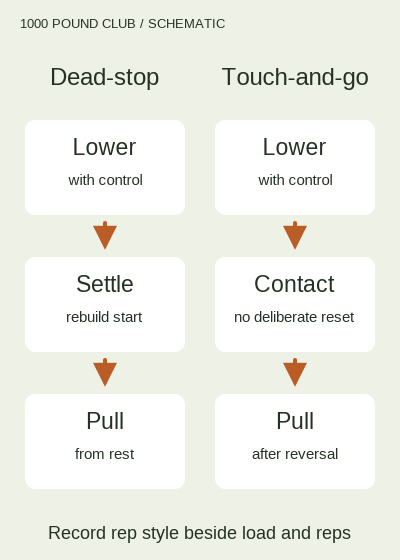
A dead-stop set includes an intentional settled floor condition. The lifter can retain a grip or release and reset it, but that choice should be noted. Settling the plates and rebuilding the start gives another opportunity to practise the first-pull task. It also takes time and requires active attention to the setup on each repetition.
Touch-and-go connects the lowering phase to the next pull. The plates contact the floor and the lifter reverses without the same deliberate reset. How controlled that contact is matters: a lightly controlled touch and a forceful bounce are not equivalent just because both are called touch-and-go. Keep that distinction visible when reviewing footage.
Sources: Greg Nuckols: How to Deadlift
Why the first rep and later reps can differ
The first pull in either set generally begins from a resting bar. Later touch-and-go reps follow an eccentric lowering phase and immediate reversal, while later dead-stop reps begin after the bar has settled. That changes the starting condition. It helps explain why a repeated set can look easier after the first rep without proving a larger fresh floor single.
Nuckols’ deadlift guide discusses both methods and cautions that touch-and-go sets can make rep-max predictions especially misleading. His practical emphasis is maintaining the intended technique, not declaring that one label makes every set good or bad. A reset with a poor rebuilt position is not automatically better practice than a controlled continuous set.
Neither label describes the grip aid, stance or plate behavior by itself. Bumper plates on one floor can rebound differently from other equipment. If the comparison is about progress, keep those conditions alongside the style rather than crediting every extra rep to strength alone.
Sources: Greg Nuckols: How to Deadlift
A competition attempt is a single lift
An IPF deadlift attempt is one pull under the rules of performance, with the required finish and down command. A touch-and-go rep set is a training format, not a sequence of separate official attempts. Likewise, a dead-stop gym set does not become an official result simply because the plates pause on the floor.
Keep competition-standard practice, gym work sets and meet results in distinct fields. Straps, grip, commands and the finish still matter. If a training set has five completed reps, record those five reps under its conditions; do not add a calculated sixth number to the completed-single ledger.
A sample comparison with the right labels
| Entry | Conditions | Result | What can be compared |
|---|---|---|---|
| A | 100 kg; conventional; dead-stop; no straps | 5 reps; rebuilt start each time | Other sets with this reset policy |
| B | 100 kg; conventional; controlled touch-and-go; no straps | 7 reps | Other controlled touch-and-go sets |
| C | 100 kg; conventional; bounced later reps | 8 reps | Different return behavior; flag it |
Entry B is not a two-rep improvement in the exact task measured by A. Entry C needs its bounce note rather than overwriting B as the same type of record. You can still retain all three entries as training history; the important part is not combining them into a misleading trend line.
Session order, rest and effort are additional context. A fresh set and one performed after demanding squats may not be directly comparable even with the same rep style. Use the notes to identify these changes, and avoid turning one harder session into a diagnosis of lost strength.
A worked example of what a calculator does not know
For a 100 kg set of five, the Epley calculation gives 100 × (1 + 5/30), or about 116.7 kg. Brzycki gives 100 × 36/(37 − 5), or 112.5 kg. The formulas use only load and reps; neither asks whether the plates settled, bounced or were pulled with straps. The gap between the formulas already shows why the output is an estimate rather than a completed lift.
If touch-and-go returns let you perform more repetitions than fresh floor starts would, entering the higher rep count can raise the estimate without proving a higher first-pull maximum. Do not fix that by subtracting an invented universal percentage. Keep style-specific estimate trends if useful, and use actual completed singles for the completed-single record.
Choose a rep policy that matches the practice goal
- For repeated floor-setup practice, specify settled plates and a deliberate rebuilt start.
- For continuous rep work, specify controlled contact and whether grip stays fixed.
- Record stance, straps, equipment, effort and any departure from the intended policy.
- Stop a set when the chosen movement can no longer be controlled; do not chase the rep target through a new bounce.
- Review comparable sessions before changing the rep policy or declaring a plateau.
The selected routine or coach should determine how the method fits your training. This page does not replace its progression rule or prescribe one reset duration for everyone. What matters for the comparison is an explicit, repeatable policy. If you change it deliberately, start a clearly labelled series rather than hiding the change in a generic deadlift field.
Download the variation log to keep rep style next to the actual result. If your broader deadlift performance has stopped improving, use the plateau checklist to review setup, attendance and workload together. A rep-style change can explain part of a record difference, but it does not settle every question about the program.
Sources and scope
These references support the specific factual points cited above. The examples and decision aids are original illustrations, not individualized coaching or medical advice.
- Greg Nuckols: How to Deadlift
Coaching reference checked November 23, 2026, including stance, Romanian deadlifts and reset versus touch-and-go reps. We do not adopt its specific mobility protocol or infer injury rates.
- IPF Technical Rulebook, March 2026 v3
Current English version on the IPF rules page, checked November 23, 2026. Rules of performance and equipment define competition eligibility; our training examples are separate.
A goal worth keeping track of.
1000 Pound is building a mobile app around your squat, bench, deadlift, and the real singles that make up your total. Coming soon for iOS and Android.
Release news and the current first-year-free offer. No payment details needed.