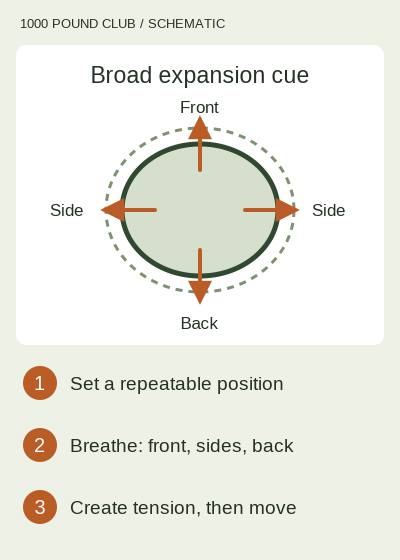
Set the trunk, breathe into a broad expansion cue, then create tension before the loaded movement. Practise the sequence with and without a belt.
Breathing and bracing are related, different actions
Taking a breath moves air into the lungs. Bracing adds muscular tension around the trunk so the position is supported during the task. The common instruction to breathe into your belly is a cue, not a claim that air enters the abdomen. A visible stomach movement alone does not establish a useful brace.
Chad Wesley Smith and Marisa Inda’s Juggernaut coaching explanation uses circumferential expansion and 360-degree pressure as a teaching idea. Think of making space around the front, sides and back of the trunk rather than only pushing the belly forward. That cue helps organize practice; it is not a demand for maximal expansion or a measurable target for every person.
Sources: Chad Wesley Smith and Marisa Inda: Breathing and Bracing; Greg Nuckols: How to Squat; Greg Nuckols: How to Deadlift
A light practice sequence before the working sets
- Choose a stable stance and a comfortable, repeatable trunk position before adding a demanding load.
- Use the coach’s broad expansion cue as you take a comfortable breath.
- Create tension around the trunk rather than simply drawing the abdomen inward or arching harder.
- Keep that organized position during a small, controlled squat or hinge practice.
- Reset and breathe normally between practice repetitions as needed; do not turn the drill into an endurance breath hold.
This sequence is our teaching summary, not a medical breathing protocol. Exact breathing timing changes with the lift, rep structure, load and individual needs. A coach can help you coordinate the setup without guessing from a written cue. If breath holding is restricted for you or produces concerning symptoms, get individual guidance rather than following a generic duration from the internet.
Do the first attempts without a heavy bar. The goal is to recognize a repeatable action before it is obscured by a difficult rep. More forceful is not automatically better: if the cue makes you dizzy, lose position or rush the next breath, stop and reassess the practice.
Sources: Chad Wesley Smith and Marisa Inda: Breathing and Bracing
Apply it to the squat setup
Set the bar securely, unrack under control and finish the walkout before preparing the squat rep. Then establish the chosen stance, breathing and trunk tension before descending. A brace taken while still shuffling into place can be difficult to reproduce. Keep the number of setup actions small enough that you can follow them consistently.
The trunk position should support the squat you are actually performing, including its bar placement. Do not create a bigger lower-back arch just to feel more rigid. Bracing is not a replacement for balanced foot pressure, a secure bar shelf or an appropriate load. Those pieces work together, and a lost bar position cannot be corrected by repeating the word tight.
For repeated reps, use an individual breathing and reset strategy that you can maintain. This guide does not prescribe holding one breath across an entire set. If you need to pause at the top to reorganize, record that choice rather than rushing a fatigued descent to preserve an imagined tempo rule.
Sources: Greg Nuckols: How to Squat
Apply it before the bar leaves the floor
The deadlift begins from a different posture, with the bar on the floor. Establish foot and hand placement, organize the trunk, and create tension before starting the pull. Different lifters coordinate the breath and descent into the setup differently; the useful check is whether the brace is established before the demanding movement, not whether everyone copies the same ritual.
Nuckols describes pulling slack out and building tension rather than jerking a loose system from the floor. Use a light load to practise that coordinated start. It does not mean holding the bar suspended for a prescribed interval, and it does not remove the need to learn the stance and grip.
On dead-stop repetitions, deliberately rebuild the setup after the plates settle. A reset creates an opportunity to rebrace, but it does not guarantee that you actually do so. On touch-and-go work, keep the selected lowering control and tension; do not interpret continuous reps as permission to bounce away from the intended position.
Sources: Greg Nuckols: How to Deadlift
A belt adds contact, not an automatic brace
A belt can provide tactile feedback around the trunk and change how a setup feels. It still requires you to organize the breathing and muscular tension. Tightening it as far as possible is not a complete technique instruction, and the belt should not prevent you from reaching the intended squat or deadlift position.
| Question | What to practise or check |
|---|---|
| Can I create tension? | Light practice of the breathing-and-bracing sequence |
| Does the belt fit this movement? | Position and tightness that permit the setup |
| Is the belt competition-eligible? | Federation size, material and approval rules |
| Does it guarantee protection? | No guarantee follows from wearing equipment |
Keep eligibility in the belt-rules guide. This page addresses the setup skill, not a promise that a belt prevents injury or that everyone must wear one at a chosen percentage. If you compare belted and beltless work, label those conditions in the log instead of treating the equipment change as invisible.
Sources: Greg Nuckols: How to Deadlift
A checklist for the next light practice
- The stance, bar position and grip were set before the loaded movement.
- Breathing and broad expansion were deliberate, without an exaggerated arch.
- Trunk tension was established before the descent or pull.
- The setup could be repeated after the rep.
- Any belt use and one useful cue were recorded.
Use one short observation such as rebuilt the setup before each floor pull or lost the position while rushing the walkout. A video can show external position and sequence; it cannot directly measure internal pressure. Ask for coaching feedback when you cannot tell which action changed. Keep the practice attached to a sensible warm-up instead of making it a separate maximal-effort test.
Sources and scope
These references support the specific factual points cited above. The examples and decision aids are original illustrations, not individualized coaching or medical advice.
- Chad Wesley Smith and Marisa Inda: Breathing and Bracing
Juggernaut coaching explanation of circumferential expansion and 360-degree pressure, checked November 23, 2026. Used as a teaching cue, not a medical instruction or a prescribed breath-hold duration.
- Greg Nuckols: How to Squat
Coaching and biomechanics reference checked November 23, 2026. Supports setup concepts, not an individualized stance, an injury prediction or our illustrative loads.
- Greg Nuckols: How to Deadlift
Coaching reference checked November 23, 2026, including stance, Romanian deadlifts and reset versus touch-and-go reps. We do not adopt its specific mobility protocol or infer injury rates.
A goal worth keeping track of.
1000 Pound is building a mobile app around your squat, bench, deadlift, and the real singles that make up your total. Coming soon for iOS and Android.
Release news and the current first-year-free offer. No payment details needed.