Define the RDL’s range and knee position, then record it separately from floor pulls. Do not chase floor contact at the expense of control.
The start position changes the sequence
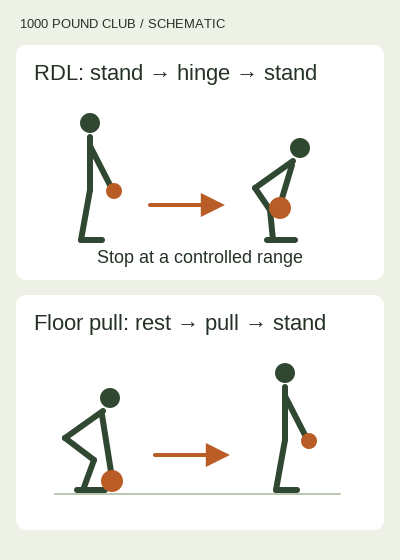
For an RDL, first get the bar into a secure standing position, then hinge the hips back while keeping a modest knee bend and the bar close. Return by extending the hips without making an exaggerated lean-back the goal. How the bar is initially picked up or unracked is preparation; it does not turn every subsequent RDL rep into a fresh floor start.
For a conventional deadlift, set up with the plates on the floor and perform the pull from that starting position. A rep set can use resets or touch-and-go returns, which should be labelled separately. Both exercises involve a hinge, but the start, knee movement and bottom condition make them different tasks.
Sources: Greg Nuckols: How to Deadlift
An RDL bottom is not a floor-contact requirement
Use a range in which you can control the hinge and maintain the intended position. The bar may finish around the knees or farther down the shins depending on the lifter, load and chosen technique. Do not force it lower simply to imitate the drawing or earn a floor touch. If the movement changes into additional knee bending just to reach the plates down, you have changed the task you were trying to practise.
Nuckols discusses RDLs as controlled eccentric hinge work within a wider deadlift guide. We use that movement distinction without adopting a universal depth, tempo or mobility prescription. A feeling of stretch can be feedback, but it is not an instruction to continue into pain. Get appropriate instruction when the setup or range is unclear.
| Detail | RDL | Floor deadlift |
|---|---|---|
| First work-rep start | Standing | Plates at rest on the floor |
| Bottom condition | Controlled hinge range | Floor start or labelled rep return |
| Useful extra label | Range landmark / tempo / straps | Stance / reset style / straps |
| Result series | RDL work sets | Deadlift work sets or completed singles |
Sources: Greg Nuckols: How to Deadlift
Main-lift practice and assistance solve different jobs
A powerlifting plan may use the competition deadlift as main work and an RDL as assistance. The main task includes starting from the floor and completing the required finish. The RDL task can emphasize controlled repeated hinge work within the selected range. It does not need to match the main lift’s weight or rep prescription to have a clear role.
Decide whether the RDL replaces other assistance or adds to the week. Three extra sets are still extra work, even when you call them accessories. The accessory-selection guide helps connect an exercise to a purpose, while the deadlift plateau guide handles diagnosis. This comparison does not claim that adding RDLs fixes every slow floor pull or guarantees a larger total.
One session, two separate records
| Order | Exercise | Planned work | Log detail |
|---|---|---|---|
| 1 | Conventional dead-stop deadlift | 120 kg; 3 × 3 | Floor resets; no straps |
| 2 | Romanian deadlift | 70 kg; 2 × 8 | Controlled lower; chosen mid-shin range; straps labelled |
| After training | Write actual reps and effort | Do not copy targets as results | No new completed-single PR claimed |
The RDL’s load here is independently chosen for the assistance task. It is not a recommended fraction of everyone’s deadlift. A lighter barbell can still be demanding across more reps, a controlled lowering phase or a longer personally usable range. Judge whether you completed the intended work rather than comparing the two loads as though they were competing maximal singles.
If straps are used for the RDL, note them. Grip conditions are part of a record even when grip is not the purpose of the assistance. A later strapless result or shortened hinge should not silently replace this baseline. Keep both entries so the log describes what happened.
Progress one defined RDL task at a time
- Write the intended rep range and load progression rule from the program.
- Use the same chosen range landmark and lowering control for comparable sets.
- Record actual reps, load, effort and any grip aids.
- Treat a deliberate range or tempo change as a new condition.
- Review whether the assistance fits alongside main-lift work before increasing it.
For example, repeating 70 kg for two sets of eight with a more consistent range is a useful technique observation. Raising the load to 75 kg while cutting the descent substantially shorter is not the same task with a clean five-kilogram improvement. You can choose that shorter-range variation for a reason, but label it instead of erasing the difference.
Keep the competition total and estimates separate
An RDL set does not supply a replacement input for an IPF deadlift result. The rules describe a floor pull to a completed standing finish, followed by the required command and return. Likewise, a rep-max formula run on an RDL set cannot certify what you can pull once from the floor. The formula does not know the movement’s range, lowering control or starting condition.
Use RDL trends to assess RDL work and floor-pull trends to assess floor pulls. If the long-term goal is a total, keep a separate completed-single ledger for the lifts and standards you actually use. That allows assistance progress to be visible without inflating a milestone or pressuring you to test a max just to reconcile two different exercise numbers.
Sources and scope
These references support the specific factual points cited above. The examples and decision aids are original illustrations, not individualized coaching or medical advice.
- Greg Nuckols: How to Deadlift
Coaching reference checked November 23, 2026, including stance, Romanian deadlifts and reset versus touch-and-go reps. We do not adopt its specific mobility protocol or infer injury rates.
- IPF Technical Rulebook, March 2026 v3
Current English version on the IPF rules page, checked November 23, 2026. Rules of performance and equipment define competition eligibility; our training examples are separate.
A goal worth keeping track of.
1000 Pound is building a mobile app around your squat, bench, deadlift, and the real singles that make up your total. Coming soon for iOS and Android.
Release news and the current first-year-free offer. No payment details needed.