THE SHORT VERSION
Name the sport and lifts before comparing a total. A squat used in weightlifting training does not become a third lift in a weightlifting competition.
Recognize the competition lifts
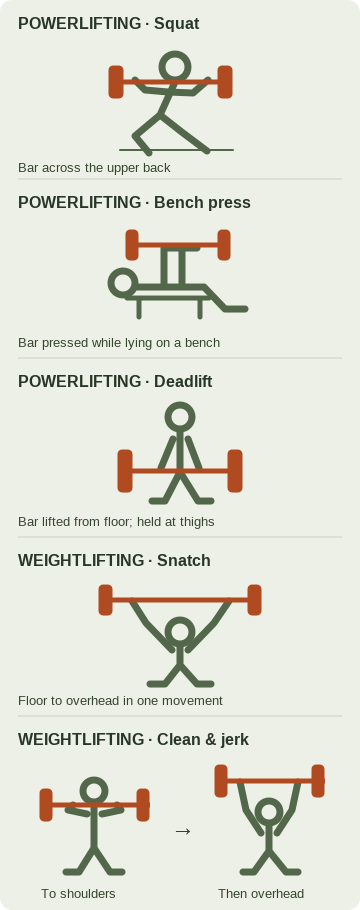
The snatch takes the bar from the floor to overhead in one movement. The clean & jerk first brings it to the shoulders, then sends it overhead. In contrast, the powerlifting deadlift finishes with the bar held at the thighs; the squat starts with the bar supported across the upper back; the bench press moves the bar while the lifter lies on a bench. These descriptions identify the lifts, not every rule for completing them.
A front squat, back squat or pulling exercise can appear in a weightlifter’s training without being a scored competition lift. Likewise, a powerlifter can practise an Olympic lift without adding it to an SBD total. Label training exercises and sport results separately when you use a shared log.
Sources: IPF Technical Rulebook, March 2026 v3; IWF Technical and Competition Rules & Regulations, October 2026
Compare the competition formats
| Question | Powerlifting | Olympic weightlifting |
|---|---|---|
| Scored lifts | Squat, bench press, deadlift | Snatch, clean & jerk |
| Ordinary attempt allowance | Three per lift | Maximum three per lift |
| Total | Best accepted result in each of the three lifts, added | Best snatch plus best clean & jerk |
| Missing a lift result | No full three-lift total | No total without a successful result in both lifts |
| What rules to read | The chosen powerlifting federation | The chosen weightlifting federation / IWF rules where applicable |
A full competition rulebook also covers categories, equipment, attempt order and judging. The table deliberately stops short of reproducing those systems. Local event details still matter. Before entering, check which organization sanctions the event and whether the published information refers to training, an informal challenge or a sanctioned competition.
Sources: IPF Technical Rulebook, March 2026 v3; IWF Technical and Competition Rules & Regulations, October 2026
Work through two different totals
| Record | Accepted best lifts | Addition | Result label |
|---|---|---|---|
| Powerlifting example | 150 squat; 100 bench; 180 deadlift | 150 + 100 + 180 | 430 kg SBD total |
| Weightlifting example | 80 snatch; 100 clean & jerk | 80 + 100 | 180 kg weightlifting total |
The 430 and 180 answer different questions. Their ratio is not a strength score between the sports, and the larger number does not establish a more difficult achievement. A kilogram is the same unit, but the measured tasks differ. Keep the name of the sport attached when sharing a screenshot, planning an event or comparing your own progress.
Do not add a separate clean and separate jerk to make a competition clean & jerk result. The example’s 100 kg represents one accepted clean & jerk. Similarly, a powerlifting total cannot substitute a front squat for its back squat or a trap-bar pull for its competition deadlift. Preserve useful training records without relabelling them as the sport’s total.
What changes in a training plan?
Begin with the lift you want to learn and the setting where you can practise it. A plan built around squat, bench and deadlift provides repeated work on those tasks. A plan aimed at snatch and clean & jerk needs practice of those lifts and their constituent skills. Shared exercises do not make either plan a complete preparation for the other sport.
As a planning exercise, mark each session with its primary purpose: practising the competition lift, building strength with an assistance exercise, or general activity. If the goal is learning a snatch but every marked session is a conventional powerlifting workout, the missing item is skill practice rather than a more impressive SBD total. Discuss that gap with a coach familiar with weightlifting.
This does not prescribe a universal weekly split, an ideal body type or a fixed speed-versus-strength percentage. Training choices depend on the actual lifter and routine. Keep the comparison useful: identify what the plan rehearses, where instruction is needed, and which outcomes you will record.
Choose a useful first step
- If your goal is a squat-bench-deadlift total: read the lift standards, learn suitable setups and choose a routine matching your experience.
- If your goal is snatch and clean & jerk: look for instruction and facilities that explicitly teach those lifts.
- If you are undecided: observe a session or meet in each sport and ask what beginner instruction looks like.
- Before buying equipment: check what the facility provides and what the actual event requires.
Someone already comfortable with the powerlifts may still be new to weightlifting. Keep that beginner status visible when choosing instruction and working loads. A known deadlift max is not an instruction to attempt a corresponding clean. Conversely, experience catching a bar overhead does not establish a paused-bench record. Start with the task you can currently perform and the help available.
Keep both sports in one log without mixing them
Use separate fields for exercise, variation, load, repetitions and result type. For a competition result, add the event, date and accepted status. You can maintain a clean record of a snatch session alongside a squat session without forcing them into one grand total. A progress chart should say exactly which exercise and conditions it displays.
A useful review might say “completed 80 kg snatch at the meet” or “completed 150 kg back squat in practice.” Those are concrete records with different contexts. If you also track the 1,000-pound milestone, calculate it from your completed squat, bench and deadlift singles, retain their dates and distinguish a gym PR sum from one-meet results.
Sources and scope
These references support the specific factual points cited above. The examples and decision aids are original illustrations, not individualized coaching or medical advice.
- IPF Technical Rulebook, March 2026 v3
Checked November 27, 2026 against the current official technical-rules page. Supports IPF-specific competition and equipment rules; examples are our own.
- IWF Technical and Competition Rules & Regulations, October 2026
Current official rules download checked November 27, 2026; sections 2.1–2.3 define the lifts, attempts and total. Illustrative loads and next-step map are original.
A goal worth keeping track of.
1000 Pound is building a mobile app around your squat, bench, deadlift, and the real singles that make up your total. Coming soon for iOS and Android.
Release news and the current first-year-free offer. No payment details needed.