Use front squats for a defined training purpose and log them separately. Do not convert a front-squat set into a back-squat PR or a competition total.
Where the bar sits changes the task
In a front squat, the bar is supported on the front of the shoulders in a front-rack position. The hands help maintain that rack rather than supporting the entire weight through the wrists. In a back squat, the upper-back shelf supports the bar, with high-bar and low-bar placements available. Both require a setup the lifter can control throughout the movement.
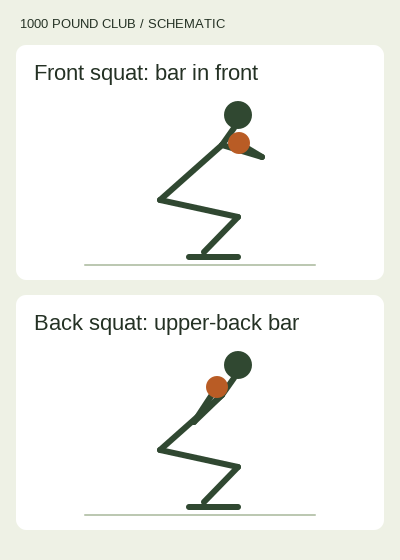
Moving the bar forward commonly changes how upright the lifter must remain to keep the system balanced. Do not translate that observation into a claim that one version removes all back work. Nuckols’ comparison discusses how bar location and the load used interact with trunk demands. The appearance of an upright torso is not a direct measure of how hard every muscle is working.
Sources: Greg Nuckols: How to Squat; Greg Nuckols: High Bar and Low Bar Squatting 2.0
Compare the practical requirements
| Question | Front squat | Back squat |
|---|---|---|
| Bar support | Stable front rack on shoulders | Stable upper-back shelf |
| Arm position | Front-rack option you can control | Grip supports the chosen back position |
| Useful record detail | Rack style, shoes, depth | High/low bar, stance, shoes, depth |
| Typical programming role here | Assistance / selected variation | Competition-specific main lift |
The front rack can be a skill constraint before leg effort is the constraint. If you cannot support the bar consistently, an old back-squat work weight is not a sensible starting target. Practise with suitable equipment and help. Different front-rack grips also need labels; a changed support method can affect what you are learning and which sets are comparable.
The diagram is a cue to recognize the equipment relationship, not a template for forcing your elbows or torso to an exact angle. A successful setup needs to work with your proportions and range of motion. Set rack safeties for the lift and learn how to end an unsuccessful rep with qualified instruction.
Which squat counts in a powerlifting total?
The IPF squat rule places the bar horizontally across the shoulders, no lower than posterior-deltoid level. A front-rack squat is not the competition back squat described by that rule. A front-squat record belongs in a front-squat record field; it is not a replacement number in a rules-based SBD total. An informal challenge can define its own requirements, so read the organizer’s standard too.
For the club calculator, use completed lifts that fit the record type you are tracking. Keep a gym training total, a meet total and an assistance-exercise best distinct. This makes a milestone more meaningful: the arithmetic only answers a useful question when the three inputs refer to the lifts the chosen standard actually includes.
Give the front squat a job, not a guaranteed carryover
A coach or program may use front squats as another squat exposure or as assistance alongside competition work. State the purpose in the plan: practise a front rack, train a selected variation, or add an appropriate amount of squat work. None of those purposes establishes that a particular front-squat increase will produce a fixed back-squat increase.
If the current routine specifies a competition back squat, do not replace every session with front squats and still describe the preparation as unchanged. Conversely, adding front squats after all existing work raises workload. Decide whether you are replacing assistance or adding it, and check that the session still fits available time and the rest of the week.
One main-lift and assistance example
| Order | Exercise | Planned work | Record field |
|---|---|---|---|
| 1 | Low-bar back squat | 100 kg; 3 × 3 | Competition-style back-squat practice |
| 2 | Front squat | 60 kg; 2 × 5 | Front squat / chosen rack style |
| Review | No maximal single performed | Record actual reps and effort | Leave completed-single PRs unchanged |
This is an accounting example, not a suggested session for every lifter. Its important feature is the separation of roles and records. The front squat has its own chosen load; it is not calculated as a mandatory percentage of the back squat. If the front-rack position limits the second exercise, note that fact instead of interpreting it as proof that your legs suddenly became weaker.
Next time, compare front-squat work under similar order, rep and rack conditions. A front squat performed first may feel different from the same work after demanding back squats. If you change the order, keep that in the notes so the difference does not become a misleading progression claim.
What to keep after a few weeks
- Can you repeat the front-rack support and intended movement?
- Does the assistance have a clear role in the selected routine?
- Is the main back-squat work still getting the planned practice?
- Are completed reps, effort and session time manageable?
- Have you kept front- and back-squat records separate?
Use those observations to discuss whether to retain, change or remove the variation. A front squat is not required for membership in a strength milestone, and a back squat is not a substitute for front-rack practice when that is the actual task. Choose the exercise for the job and evaluate that job directly, rather than treating every barbell number as another version of the same PR.
Sources and scope
These references support the specific factual points cited above. The examples and decision aids are original illustrations, not individualized coaching or medical advice.
- Greg Nuckols: How to Squat
Coaching and biomechanics reference checked November 23, 2026. Supports setup concepts, not an individualized stance, an injury prediction or our illustrative loads.
- Greg Nuckols: High Bar and Low Bar Squatting 2.0
Coaching analysis checked November 23, 2026. Bar location and whole-body mechanics interact; its models are not universal joint angles or a guaranteed performance difference.
- IPF Technical Rulebook, March 2026 v3
Current English version on the IPF rules page, checked November 23, 2026. Rules of performance and equipment define competition eligibility; our training examples are separate.
A goal worth keeping track of.
1000 Pound is building a mobile app around your squat, bench, deadlift, and the real singles that make up your total. Coming soon for iOS and Android.
Release news and the current first-year-free offer. No payment details needed.