Measure the grip you use, keep the thumb wrapped around the bar, and compare sets with matching pause and setup conditions.
Define the two grips on the actual bar
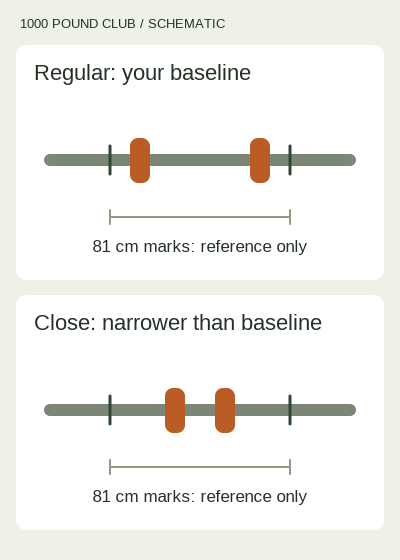
Start by writing where your index fingers sit relative to known bar marks, or measure their spacing. Then choose a narrower position you can repeat for the close-grip variation. Bar markings vary, so index finger one thumb-length inside the ring is only reproducible if the ring and bar are identified. The most useful detail is the one you can recreate next session.
A very narrow grip is not automatically a better close grip. Arrange the hands, wrists and forearms so you can control the bar through the intended movement. Use suitable spotting and safeties while learning. Avoid treating a fixed hand spacing from another lifter as a requirement for your own proportions.
Sources: Greg Nuckols: How to Bench Press
What changes when you move the hands inward?
Moving the hands changes the geometry of the press, including the relationship of elbows, shoulders and bar path. Nuckols discusses how grip and elbow positioning interact rather than operating as independent switches. A narrower grip often involves a longer bar travel and a different balance of movement demands, but the exact result depends on the lifter and setup.
Close-grip bench is still a compound press; it does not isolate the triceps or remove the chest from the lift. Nor does the name establish that it is universally safer for shoulders or elbows. Treat comfort, control and training purpose as observations to assess, without turning a mechanical tendency into a medical claim.
| Field | Regular-grip entry | Close-grip entry |
|---|---|---|
| Hand position | Your recorded baseline | A measured narrower position |
| Pause | Paused or touch-and-go, labelled | Same condition if comparing |
| Load | Appropriate to this task | Chosen for this variation |
| Progress series | Regular bench | Close-grip bench |
Sources: Greg Nuckols: How to Bench Press
The IPF width rule is a maximum, not a prescription
The current IPF rule limits hand spacing to 81 cm measured between the forefingers. Both forefingers must be within the marks, and the whole forefingers must contact the marks when a maximum grip is used. It also requires a thumb-around grip and forbids reverse grip. This is a competition limit; it does not tell every lifter to use the widest legal position.
A narrower grip can be eligible if the entire lift satisfies the rules. Close-grip is not a separate exception to the bench commands, contact requirements or elbow-depth rule. Similarly, merely staying inside the rings does not make a rep valid. The paused-bench guide covers the full movement and judging context.
Decide whether it is main work or assistance
Your regular grip may be the competition grip you intend to use, while close grip is assistance in the selected routine. Another lifter may compete with a relatively narrow grip. Define the roles by the actual program and competition task rather than assuming close grip always means accessory or regular always means wide.
If a routine prescribes close-grip work, preserve its own sets, reps and progression. Adding it on top of every existing press increases workload. Replacing all regular-grip practice changes specificity. Either choice can be deliberate, but it should be visible in the plan so you can tell whether the variation is doing the intended job.
A session example with separate comparisons
| Task | Hand position | Completed work | Compare with |
|---|---|---|---|
| Priority paused bench | Regular; measured baseline | 70 kg × 3 for 3 sets | Other paused regular-grip work |
| Assistance bench | Close; recorded narrower spacing | 50 kg × 6 for 2 sets | Close-grip work in the same session slot |
| Later close-grip session | Same grip, now performed first | 50 kg × 6; easier effort | Note the changed order before claiming progress |
The weight difference between rows is not a conversion factor. Reps, effort and session order differ as well as grip. A sensible close-grip starting load is one you can control for the actual prescribed task. Do not calculate it from a social-media ratio and assume the result is appropriate.
Pause style also needs its own column. If one session uses a motionless pause and the next rebounds from the chest, the result is not explained by grip width alone. Keep the old entry and add the new conditions instead of relabelling them both simply as bench.
A short setup check before progressing
- Confirm the bar and finger landmark or measured spacing.
- Use a complete thumb-around grip and a controllable wrist position.
- Repeat the chosen pause and touch location without bouncing.
- Record actual load, reps, effort and exercise order.
- Progress through the routine’s rule after comparable successful work.
The variation log includes grip, pause, equipment and notes fields. Use them to keep an honest history while you learn. If a regular-grip bench has stalled, review that pattern through the plateau checklist; a close-grip result is supporting information, not a diagnosis. Changing hand position may give you another training task, but it does not by itself explain a missed regular-grip rep.
Sources and scope
These references support the specific factual points cited above. The examples and decision aids are original illustrations, not individualized coaching or medical advice.
- Greg Nuckols: How to Bench Press
Coaching and biomechanics reference checked November 23, 2026. Supports grip and leg-drive discussion; current competition rules come from the IPF, not this older guide.
- IPF Technical Rulebook, March 2026 v3
Current English version on the IPF rules page, checked November 23, 2026. Rules of performance and equipment define competition eligibility; our training examples are separate.
A goal worth keeping track of.
1000 Pound is building a mobile app around your squat, bench, deadlift, and the real singles that make up your total. Coming soon for iOS and Android.
Release news and the current first-year-free offer. No payment details needed.