THE SHORT VERSION
Ask whether the accessory supports the wrist or helps hold the bar. Product names can be confusing; follow the physical path of the material.
A visual check: does it connect to the bar?
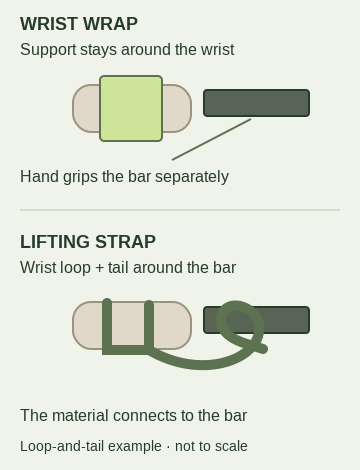
A typical wrist wrap has elastic fabric, a fastening tab and sometimes a thumb loop used during application. Once fastened, its main material stays around the wrist. A common lifting strap has a wrist loop and a longer tail that winds around the implement. Figure-eight straps have a different shape but still connect the lifter to the implement.
The product examples in our sources make the distinction concrete: Rogue describes its Wrist Wraps as elastic wrist support with a thumb loop and closure, while its Ohio Lifting Straps use cotton webbing for pulling movements. Those pages establish construction and intended use, not a medical benefit or a ranking of brands.
Sources: Rogue Wrist Wraps: construction and intended use; Rogue Ohio Lifting Straps: loop-and-tail construction
Match the item to the task
| Question | Wrist wrap | Lifting strap |
|---|---|---|
| Where does it go? | Around the wrist | Around the wrist or hand and implement |
| Main task | Adjustable wrist support | Grip assistance for a pull |
| Typical context | Pressing and other lifts where chosen | Deadlifts, rows or similar pulling work |
| Does it replace your grip? | No connection to the bar | Changes how the implement is held |
For example, a lifter who loses a row because the fingers open is describing a grip problem. A wrist wrap does not provide the same bar connection as a strap. Conversely, straps do not serve as a substitute for arranging the bar, hand and forearm in a controlled bench-press setup. Identify the problem before selecting an accessory.
Neither category is mandatory for ordinary training. If you can complete the planned work comfortably with the intended grip, a new accessory may not solve a current problem. If you do introduce one, begin with familiar light work and follow its instructions rather than using a heavy set to discover how it fastens or releases.
Sources: Rogue Wrist Wraps: construction and intended use; Rogue Ohio Lifting Straps: loop-and-tail construction
IPF rules distinguish wraps from grip aids
Under the March 2026 IPF rulebook, wrist wraps may be no more than 1 m long and 8 cm wide, including their fastening components. The covering may extend no more than 10 cm above and 2 cm below the wrist-joint center, with a maximum covering width of 12 cm. The application loop must be removed from the thumb or fingers for the actual lift.
Those dimensions do not authorize material running from the wrist around the bar. Lifting straps are not an allowed IPF competition grip aid. The rulebook's lifting and personal-equipment requirements still apply even when a shop calls an item a 'wrist strap'. For a meet, check the exact model against the current approved list and ask officials about anything ambiguous.
This section is federation-labelled deliberately. Do not assume that a strongman event, weightlifting training session and IPF meet use the same equipment policy. An accessory can be useful in one training context and ineligible in another competition. A manufacturer describing a product as suitable for powerlifting does not override the competition rules.
Sources: IPF Technical Rulebook, March 2026 v3; IPF approved equipment and notices
Keep grip practice and strapped assistance distinct
If you are preparing for an unstrapped deadlift, retain practice under that intended condition. You might separately use straps for assistance work when your program calls for them. Label the difference rather than treating the strapped assistance load as proof of an unstrapped competition single. This is a record-keeping choice, not a rule that straps make all training better or worse.
Our deadlift-grip guide covers double-overhand, mixed grip, hook grip and strap-specific comparisons in more depth. This page's decision is earlier: identify the object and decide whether you need wrist support or grip assistance. Do not change your grip style, repetition style and accessory together and then assign the result to one item.
Use an equipment-labelled training record
| Record | Accessory | Useful interpretation |
|---|---|---|
| Bench press, completed single | Wrist wraps; model recorded | A wrapped-wrist bench record under stated standards |
| Romanian deadlift, eight reps | Loop straps | Strapped assistance work, not a competition deadlift single |
| Deadlift, completed single | No straps; grip recorded | Comparable to later singles with the same conditions |
Include the exercise, load, reps, bar and accessory in the same entry. The equipment-comparison CSV supplies those fields and a place for the next check. It does not calculate a conversion between strapped and unstrapped lifts, because this guide has no evidence for a universal conversion. Compare like records when judging progress.
Check what you are buying and practising
- Name the task: wrist support or grip assistance.
- Inspect whether the material remains on the wrist or connects to the implement.
- Read that product's fitting, use and inspection instructions.
- For competition, check the current federation rules and precise product eligibility.
- Practise with familiar light loads and record the new equipment condition.
Do not treat either accessory as a diagnosis or a guaranteed fix for pain. If a setup feels wrong, stop and reassess the lift and equipment instead of adding more tension. The practical result of this comparison is simple: your description, training log and meet bag should all refer to the same item.
Sources and scope
These references support the specific factual points cited above. The examples and decision aids are original illustrations, not individualized coaching or medical advice.
- Rogue Wrist Wraps: construction and intended use
Product description and gear specifications checked November 25, 2026. Supports elastic support, thumb-loop and closure identification only; product marketing is not independent evidence of health effects.
- Rogue Ohio Lifting Straps: loop-and-tail construction
Product description checked November 25, 2026. Supports cotton webbing, wrist/implement connection and intended pulling use. Other strap designs differ.
- IPF Technical Rulebook, March 2026 v3
Sections 3.9, 3.11 and 4 support wrist-wrap dimensions and thumb-loop removal, grip-aid distinctions and lifting requirements. Official current-version link and relevant text checked November 25, 2026; applies to IPF competition.
- IPF approved equipment and notices
Checked November 25, 2026. Use the current model list and notices, not a generic shop label, when checking competition equipment.
A goal worth keeping track of.
1000 Pound is building a mobile app around your squat, bench, deadlift, and the real singles that make up your total. Coming soon for iOS and Android.
Release news and the current first-year-free offer. No payment details needed.