Write the actual bar mass and handle height. Compare progress on the same implement; there is no dependable trap-bar-to-barbell conversion.
Start with the shape and the handles
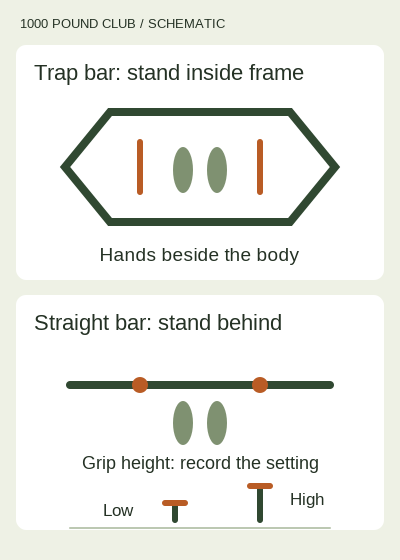
The frame gives the hands a different relationship to the body than a bar held in front of the shins. Many trap bars also offer raised handles, but not every model has the same dimensions or mass. Identify the actual equipment before treating a weight entry as comparable with another gym’s trap bar.
High handles start the hands higher than low handles on that same frame when the bar is oriented for their use. That commonly changes the distance moved and setup. Plate diameter matters too. A high-handle result and a low-handle result should be separate entries even when the plate labels are identical. The implement name alone is an incomplete record.
What the research supports, and what it does not
Swinton and colleagues studied nineteen male powerlifters using straight and hexagonal bars. They measured acute movement and mechanical variables across submaximal loads, and the sample lifted a higher mean maximum with the hexagonal bar. The choice of implement changed joint moments and other performance measures in those testing conditions.
That is evidence that the exercises can present different demands. It is not a conversion chart for your lifts, proof that one is always safer, or a long-term trial showing which exercise gives every athlete better results. The sample and equipment matter. We do not turn its average difference into a percentage you should add to or subtract from your own record.
Similarly, a more upright-looking torso does not establish that the back is unloaded. Treat the trap bar as another loaded exercise requiring a setup you can control. Choose it for a defined training task and equipment access, rather than using an acute laboratory result as a promise about injury or future strength.
Sources: Swinton et al. (2011): straight and hexagonal barbell deadlifts
Make the load entry reproducible
| Field | Example entry | Why it matters |
|---|---|---|
| Implement | Trap bar, model or identifying description | Frame dimensions vary |
| Bar mass | Verified 25 kg | Not assumed to be a 20 kg straight bar |
| Handles | High; grip 38 cm from floor | Documents starting height |
| Plates | Full-size plates; 80 kg total added | Plate radius affects the start |
| Total load | 105 kg | 25 kg bar + 80 kg plates |
The numbers in this table are invented equipment notes, not standard trap-bar specifications. Use the manufacturer’s specification or a reliable measurement for your bar. Weights include both sides and the bar, plus collars if you count them. If the bar mass is unknown, mark it unknown rather than reporting a precise total that cannot be checked.
Keep the record types separate
| Record | Appropriate input | Trap-bar substitute? |
|---|---|---|
| Trap-bar training PR | That implement and handle setting | It is its own result |
| Straight-bar gym deadlift | Labelled stance, setup and aids | No automatic conversion |
| IPF meet deadlift / total | Eligible competition lift and official result | No |
| Informal challenge | Organizer’s stated lift and equipment rules | Check its actual rules |
An IPF total uses its specified squat, bench press and deadlift with regulated equipment. A frame surrounding the lifter is not the competition barbell described in that rulebook. If you choose to track a personal three-exercise challenge using a trap bar, label it that way; do not present the sum as a comparable IPF SBD total.
The same principle applies to our milestone examples. Changing one input exercise changes what the sum describes. An honest separate record is still useful progress, and it avoids making the club calculator appear to certify an equipment standard that the arithmetic cannot verify.
Choose the exercise for the intended work
For someone preparing to compete, straight-bar deadlift practice remains the specific task to prepare. Trap-bar work can be assistance or part of another training goal when the program specifies its role. For someone training general strength without a meet, there may be no reason to choose an exercise solely because it appears in a powerlifting total.
A higher handle setting is a different range of motion, not a free increase in the same lift. If you change settings to fit a session goal, start a separate comparison and use an appropriate load. Do not keep adding plates to preserve an old percentage based on the other implement. The load that fits one setup may not fit the next.
A fair way to record progress
Imagine 105 kg for five controlled high-handle reps this week and the same work at 110 kg two weeks later, with the same bar, plate height and session position. That is a useful high-handle comparison. A 95 kg low-handle set on another day belongs in another series. Neither number predicts a specific straight-bar single.
Use the variation log to keep implement, mass, handle height, rep style and effort beside the result. If you later return to straight-bar pulling, establish a current baseline for that task rather than converting from the trap bar. This preserves a clear training history and lets you see which exercise has actually changed.
Sources and scope
These references support the specific factual points cited above. The examples and decision aids are original illustrations, not individualized coaching or medical advice.
- Swinton et al. (2011): straight and hexagonal barbell deadlifts
Acute biomechanics study in 19 male powerlifters, checked November 23, 2026. Implement changed measured demands and performance in this sample; it does not establish injury risk, long-term superiority or a conversion formula.
- IPF Technical Rulebook, March 2026 v3
Current English version on the IPF rules page, checked November 23, 2026. Rules of performance and equipment define competition eligibility; our training examples are separate.
A goal worth keeping track of.
1000 Pound is building a mobile app around your squat, bench, deadlift, and the real singles that make up your total. Coming soon for iOS and Android.
Release news and the current first-year-free offer. No payment details needed.