THE SHORT VERSION
Identify the exact bar and your competition rules. 'Olympic' can describe plate compatibility in a shop listing; it does not prove a particular shaft diameter, bearing system or competition approval.
Look beyond the end-cap weight
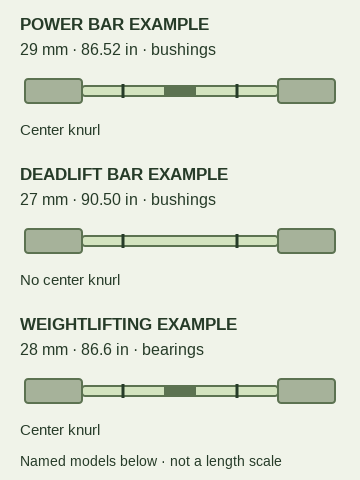
The shaft is the part you hold; sleeves carry the plates and rotate relative to it. Knurling is the textured grip, while smooth rings or markings help locate a grip width. Center knurl is a separate feature. Two bars with the same total mass can have different dimensions and surfaces, so weighing them answers only one part of the identification task.
The table uses three specific Rogue models to keep the comparison reproducible. They are examples of designs, not three universal specifications or a buying ranking. Other power, deadlift and weightlifting bars differ, including 15 kg and multipurpose bars. Check the exact model before copying any number into a training record.
Sources: Rogue 20KG Ohio Power Bar, stainless: gear specifications; Rogue Ohio Deadlift Bar, black zinc: gear specifications; Rogue Pyrros Bar, 28 mm: gear specifications
Three named models, compared directly
| Model | Shaft / overall length | Knurl and sleeve system |
|---|---|---|
| Rogue 20KG Ohio Power Bar, stainless | 29 mm / 86.52 in | Powerlifting marks; center knurl; bushings |
| Rogue Ohio Deadlift Bar, black zinc | 27 mm / 90.50 in | Powerlifting marks; no center knurl; bushings |
| Rogue Pyrros Bar, 28 mm | 28 mm / 86.6 in | Olympic marks; center knurl; bearings |
All three listed models are specified at 20 kg. The deadlift example is longer and thinner than the power-bar example; the manufacturer designs it for greater flex during pulling. That does not supply a fixed strength bonus. Load, plate placement, the individual bar and how you take up tension all affect the lift you experience.
The Pyrros example also shows why 'weightlifting bars never have center knurl' is a poor identification shortcut: this named model has it. Likewise, bushing does not mean the sleeves cannot rotate. It identifies the construction used for rotation, while the feel and maintenance condition of a particular bar still matter.
Sources: Rogue 20KG Ohio Power Bar, stainless: gear specifications; Rogue Ohio Deadlift Bar, black zinc: gear specifications; Rogue Pyrros Bar, 28 mm: gear specifications
Use markings and rotation for the right question
Powerlifting marks help locate competition bench grip width; the IPF rulebook specifies markings 81 cm apart. The named power and deadlift models describe powerlifting marks, while the Pyrros page specifies Olympic marks. A multipurpose bar may have both sets. Do not transfer your usual 'finger on the ring' cue to an unidentified bar and assume the same hand spacing.
Weightlifting includes catching and turning the bar in snatches and clean and jerks, so sleeve rotation is part of that design task. The Pyrros uses needle bearings; the two named powerlifting examples use bushings. That comparison does not prove that bearings are required for every gym session or that one rotation feel is best for every lift. Inspect the task and model together.
Sources: IPF Technical Rulebook, March 2026 v3; Rogue 20KG Ohio Power Bar, stainless: gear specifications; Rogue Ohio Deadlift Bar, black zinc: gear specifications; Rogue Pyrros Bar, 28 mm: gear specifications
A specialist deadlift bar is not an IPF meet bar
IPF specifications limit the bar to 2.2 m overall length and 28–29 mm shaft diameter, with collar-face spacing requirements and 81 cm markings. The bar-and-collars combination is specified at 25 kg. The same compliant bar is used through the competition unless officials determine that damage requires a change. World-level approval requirements also apply.
The named 27 mm Ohio Deadlift Bar therefore does not meet the IPF diameter requirement, regardless of a product page's broad statement about powerlifting use. Other federations or events may permit a specialist pulling bar. Ask which equipment will be used at your actual meet, then decide how closely your training should match it.
Do not treat a 20 kg bar and a 25 kg bar-plus-collars specification as contradictory. They describe different assemblies. Include the correct collar mass when the record counts it, and never silently replace a 20 kg bar with a 45 lb assumption. The mass guide and plate calculator handle that separate arithmetic.
Sources: IPF Technical Rulebook, March 2026 v3; Rogue Ohio Deadlift Bar, black zinc: gear specifications
Identify the bar in your gym
- Read the end cap or equipment label and ask staff for the exact model.
- Check the manufacturer's mass, shaft diameter and overall length.
- Identify which grip marks and center knurl are present.
- Record sleeve construction if it matters to your comparison; do not dismantle gym equipment.
- Check the gym's intended use and the event's rules before treating the bar as interchangeable.
Keep one stable reference bar for progress comparisons where possible. If the bar changes, record it. A 180 kg pull on a specialist deadlift bar and the same load on a power bar are both completed lifts under their stated conditions, but the second is not a controlled repeat of the first. Avoid inventing a conversion between them.
Keep design changes separate from load changes
Suppose you repeat a familiar deadlift session in another gym. Before adding weight, note the bar model, plate diameter, floor height, footwear and grip. A different bar label may explain why the setup feels unfamiliar, but it is not proof that training strength changed overnight. Use your usual warm-up to establish the day's conditions rather than forcing the previous gym's top set.
The equipment-comparison log gives you a place to retain those differences. Once the setup is identified, use the plate calculator with its real bar and collar weights. Design identification, loading arithmetic and lift completion are three separate checks; doing one correctly does not settle the other two.
Sources and scope
These references support the specific factual points cited above. The examples and decision aids are original illustrations, not individualized coaching or medical advice.
- Rogue 20KG Ohio Power Bar, stainless: gear specifications
Checked November 25, 2026: 20 kg, 29 mm, 86.52 in, powerlifting marks, center knurl and bushings. Supports this model's dimensions and construction, not all power bars.
- Rogue Ohio Deadlift Bar, black zinc: gear specifications
Checked November 25, 2026: 20 kg, 27 mm, 90.50 in, powerlifting marks, no center knurl and bushings. Manufacturer describes increased flex; no fixed performance gain is inferred.
- Rogue Pyrros Bar, 28 mm: gear specifications
Checked November 25, 2026: 20 kg, 28 mm, 86.6 in, Olympic marks, center knurl and bearing construction. Supports a named weightlifting-bar example, not all Olympic-compatible bars.
- IPF Technical Rulebook, March 2026 v3
Section 2.3 supports bar dimensions, markings, bar-plus-collars mass and use through the competition; section 4.2 supports bench grip-width context. Official version link and relevant text checked November 25, 2026. Applies to IPF, not all federations.
A goal worth keeping track of.
1000 Pound is building a mobile app around your squat, bench, deadlift, and the real singles that make up your total. Coming soon for iOS and Android.
Release news and the current first-year-free offer. No payment details needed.